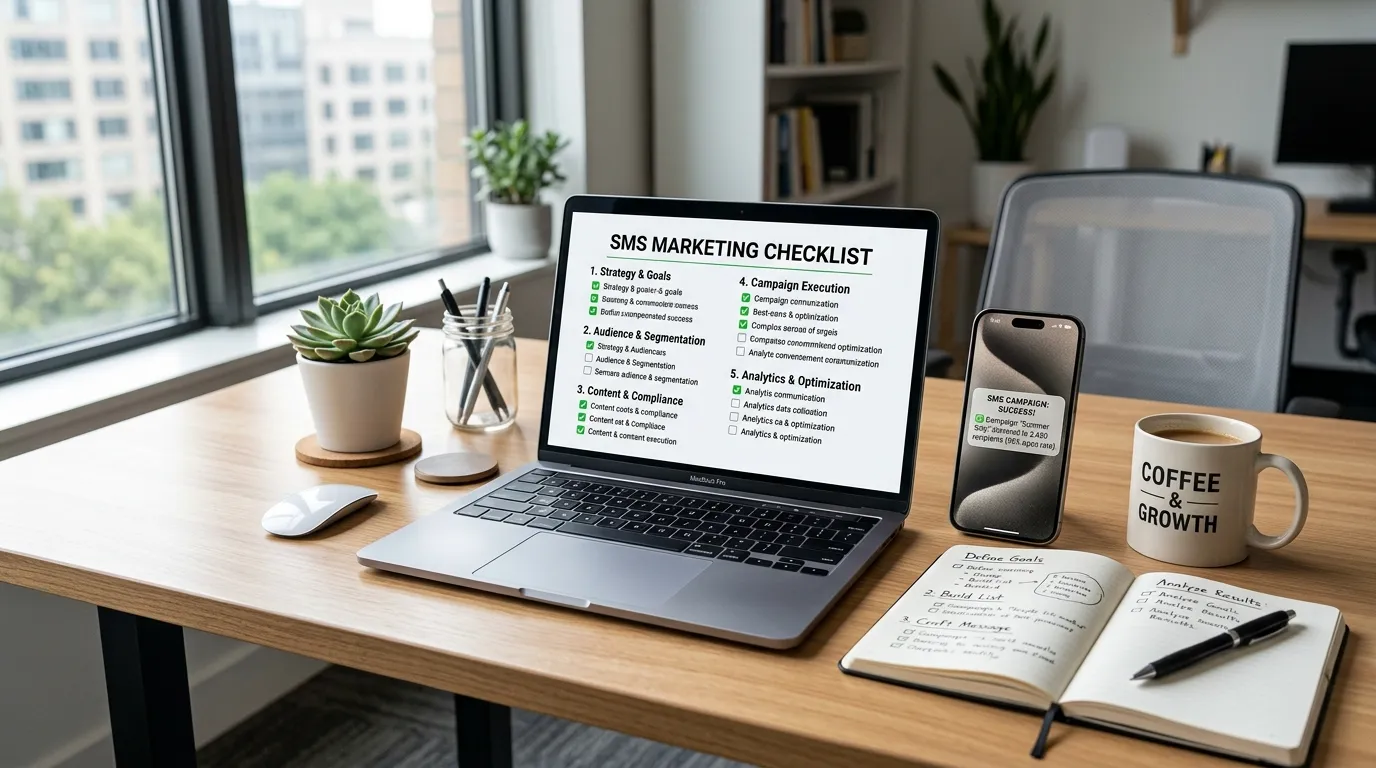
An SMS marketing checklist for businesses covers planning, setup, and optimization—defining goals, building an opt-in list, segmenting your audience, crafting compliant messages, automating campaigns, and tracking KPIs to drive measurable revenue.
Text messages reach a 98% open rate, compared to roughly 20% for email, according to Gartner (2023). Most recipients read a text within three minutes of delivery. No other channel puts your offer in front of customers that fast. Yet many businesses still launch SMS campaigns without a clear plan—and waste money sending the wrong message to the wrong people.
That is where a structured SMS marketing checklist for businesses changes everything. A good checklist turns a scattered effort into a repeatable system. It keeps you compliant, keeps your list healthy, and keeps every message tied to a real business goal.
This guide walks you through a complete SMS marketing campaign setup guide, from your first planning decision to advanced optimization. You will learn proven business SMS marketing best practices, a focused SMS marketing strategy for small businesses, and the common pitfalls that trip up most teams. By the end, you will have a clear roadmap you can use to launch your first campaign this week.
What is SMS marketing, and why does it matter for businesses?
 SMS marketing is the practice of sending promotional and transactional text messages to customers who have opted in to receive them. These messages cover flash sales, discount codes, order confirmations, shipping updates, and abandoned cart reminders—all delivered directly to a shopper’s mobile device.
Unlike email, which competes in a crowded inbox, SMS lands in the same messaging app customers use to text family and friends. That personal placement is why text messaging cuts through digital noise so effectively. Customers who opt in genuinely want brief, valuable updates from the brands they trust.
Why is SMS marketing essential for modern businesses?
Customer attention keeps shrinking, and competition for it keeps climbing. Businesses need a channel that delivers immediate results without expensive ad-bidding wars. SMS fills that gap. A single text can clear seasonal inventory, fill a slow sales day, or announce a doorbuster sale—all within minutes of hitting send.
A well-structured SMS marketing campaign delivers several clear benefits: higher engagement than any other channel, direct reach that bypasses spam filters and algorithms, cost-effective conversions, and personalization at scale. Together, these advantages turn text messaging into a reliable revenue engine.
The ultimate SMS marketing checklist for businesses
The strongest programs follow three phases: planning and strategy, campaign setup, and execution and optimization. Work through each phase in order, and you build a campaign on solid ground.
Phase 1: Planning and strategy
Skip the planning phase, and you risk wasted spend, fines, and a damaged reputation. Get it right, and everything that follows becomes easier.
1. Define your goals and objectives. Decide what you want before you send a single text. Common goals include driving immediate sales, recovering abandoned carts, building customer loyalty, and promoting new products. Each goal shapes the campaigns you run and the metrics you track.
2. Identify your target audience. Know who you are texting and what they care about. A clear picture of your ideal customer guides everything from message tone to offer type.
3. Choose the right SMS platform. Your platform determines what you can automate, how you track results, and how easily you stay compliant. Look for automation workflows, dynamic data insertion, ecommerce and CRM integrations, and real-time analytics dashboards.
4. Understand SMS marketing regulations. You cannot legally send promotional texts to anyone who hasn’t explicitly opted in. In the United States, the Telephone Consumer Protection Act (TCPA) governs mobile marketing. In Europe, the General Data Protection Regulation (GDPR) controls how businesses collect and process personal data. CTIA guidelines add further industry standards.
5. Develop a clear opt-in strategy. Plan exactly how subscribers will join your list and what they get in return. A clear value exchange—a discount, free shipping, or early access—makes the benefit of opting in obvious.
6. Craft your value proposition. Decide what makes your texts worth receiving. Subscribers stay on your list when every message delivers real value.
Phase 2: Campaign setup and implementation
With your strategy in place, it’s time to build the engine. This phase covers list building, segmentation, message creation, automation, and channel integration.
Build your SMS subscriber list
Your list quality determines your conversion ceiling. A smaller list of genuinely interested buyers beats a large list of disengaged contacts every time. Grow your list through these proven channels:
- Website opt-in forms: Use pop-ups offering a discount, plus checkout opt-in checkboxes where purchase intent is already clear.
- In-store sign-ups: Promote a keyword text-to-join campaign at the point of sale, on receipts, and via flyers.
- Keyword opt-ins: Let customers text a keyword to a short code to join your list instantly.
- Social media integration: Run text-to-join campaigns promoted across your social channels.
Segment your audience for personalization
Segmentation divides your subscriber list into smaller groups based on shared traits, then tailors each message to that group’s interests. Targeted messages dramatically outperform generic blasts in every measurable metric. Build segments using:
- Demographic segmentation: Age, gender, and product preferences.
- Behavioral segmentation: Purchase history, browsing activity, and cart abandonment.
- Purchase history segmentation: One-time buyers versus repeat customers.
- Geographic segmentation: Local offers and time-zone-aware send times.
For a deeper look at building precise segments, the SMS segmentation benefits for marketing guide breaks down each approach in detail.
Craft compelling SMS messages
Standard SMS limits you to 160 characters, so every word must pull its weight. Follow these principles:
- Conciseness and clarity: Identify your brand immediately and state the offer in the first few words.
- Strong call to action: Replace “Click here” with “Claim your 20% off now.”
- Personalization at scale: Use first names and behavioral data to make every message relevant.
- Emojis and rich media: One well-placed emoji adds personality. A string of them triggers carrier filters and looks unprofessional.
A strong example: “BRAND: 20% off sitewide — today only 🛍️ [link] Reply STOP to opt out.”
Set up automated campaigns
Automation guarantees the right message reaches the right person at the right moment, without manual effort. Build these core workflows first:
- Welcome series: Send your first text the moment someone subscribes, delivering the incentive you promised at opt-in.
- Abandoned cart reminders: Recover high-intent shoppers who left items behind.
- Order confirmations and shipping updates: Build trust and reduce support volume with timely transactional texts.
- Loyalty program messages: Notify members of point balances and rewards they’re close to unlocking.
Integrate with other marketing channels
SMS works best when it amplifies your other channels rather than operating in isolation. Connect it with email marketing for detailed announcements, social media for brand awareness, and your CRM system for a complete view of every customer. A connected CRM with text messaging lets you trigger promotions based on real shopping behavior.
Phase 3: Execution and optimization
A live campaign is never finished. This phase covers scheduling, testing, monitoring, and continuous improvement.
1. Schedule your messages for optimal impact. Send promotional texts between 9:00 AM and 8:00 PM in the recipient’s local time zone. Mid-afternoon and early evening typically generate the highest click-through rates. Limit promotional blasts to two to four per month to protect list health.
2. A/B test your campaigns. Never rely on assumptions. Test one variable at a time—offer type, CTA wording, send time, or message length—then roll out the winning version to your full list.
3. Monitor key performance indicators. Track this mix of engagement and financial metrics:
- Open rates: Confirm your messages are reaching and engaging subscribers.
- Click-through rates (CTR): Show whether your offer and CTA resonate.
- Conversion rates: Reveal what percentage of clicks result in purchases.
- Opt-out rates: Signal whether messages are too frequent or irrelevant.
4. Analyze and adapt your strategy. A spike in opt-outs signals a segment that needs adjustment. A high-converting segment is one to scale. Let the data guide every decision.
5. Follow compliance and ethical best practices. Use double opt-in, include “Reply STOP to cancel” in every promotional message, and ensure your platform processes opt-outs instantly.
What are the business SMS marketing best practices every team should follow?
 Beyond the checklist, a handful of business SMS marketing best practices separate the programs that thrive from those that fizzle out.
- Obtain explicit consent. Use a double opt-in process to confirm consent with a clear record. This protects your business legally and improves list quality.
- Provide clear opt-out options. Include a simple command like “Reply STOP to cancel” in every message. Easy opt-outs build trust and keep your list healthy.
- Maintain message relevancy and value. Every text should give the subscriber a reason to stay. Irrelevant messages are the fastest path to opt-outs.
- Respect send times and frequency. Stick to reasonable hours and cap promotional blasts at two to four per month to avoid subscriber fatigue.
- Personalize beyond just names. Use purchase history and browsing behavior to recommend products that genuinely fit each subscriber.
- Leverage two-way communication. Let customers reply with questions about sizing, shipping, or returns. Resolving queries by text increases the likelihood of a completed sale.
What is the best SMS marketing strategy for small business?
Small businesses don’t need enterprise budgets to win with SMS. A focused SMS marketing strategy for small business spends smarter, not more.
How can small businesses run SMS marketing on a budget?
Start with a free or low-cost platform. Many free SMS marketing services operate on a freemium model, giving you a set number of messages each month before you pay. This removes the financial risk of testing a new channel. Segmentation also stretches a tight budget—by sending only to the subscribers most likely to convert, you avoid paying to text people who will never act.
How do small businesses focus on local customers?
Geographic segmentation opens powerful local opportunities. Send location-based offers to subscribers near your store, distribute mobile coupons redeemable in person, or announce a local event. A well-timed text can pull nearby shoppers through your doors within the hour.
How do small businesses build community engagement?
Two-way texting turns a broadcast into a conversation. Invite replies, ask for feedback, and respond personally. This builds the kind of loyal community that larger brands struggle to replicate. Keep campaigns simple and effective—a single, well-crafted message often outperforms an elaborate sequence.
What advanced SMS marketing techniques can businesses use?
Once your core campaigns run smoothly, advanced tactics extract more value from every subscriber.
- Flash sales and limited-time offers. Because texts are read within minutes, SMS is the ideal channel for 24-hour promotions. Create genuine scarcity with specific deadlines. For a full playbook, see this SMS promotions for ecommerce guide.
- Customer feedback and surveys. Send a quick survey after purchase. High response rates make SMS one of the best channels for collecting honest feedback.
- Loyalty programs via SMS. Reward your most valuable customers with subscriber-only perks, point updates, and early access to sales.
- Event promotions. Announce in-store or online events and drive attendance with timely reminders.
What are the common SMS marketing challenges, and how do you overcome them?
 Even well-run programs hit hurdles. Knowing them in advance keeps your campaigns healthy.
- Low opt-in rates. Solve this with a stronger value exchange. Offer a clear incentive—a discount or free shipping—and promote your list everywhere customers interact with your brand.
- High opt-out rates. Cap promotional sends at two to four per month and use a preference center that lets subscribers choose their message volume. Treat a spike in opt-outs as a signal to diagnose content, timing, or frequency.
- Message deliverability issues. Clean your list regularly, avoid spam-trigger words, and limit emojis to keep messages flowing to devices.
- Measuring ROI effectively. Use trackable links and unique discount codes to attribute revenue to specific campaigns. Most platforms include dashboards that connect message performance directly to sales data.
Conclusion
A clear SMS marketing checklist for businesses turns a complex channel into a manageable system. Plan your goals and audience, build a compliant list, segment for relevance, craft tight messages, automate your core workflows, then track and refine. Follow these business SMS marketing best practices, and you protect your list while squeezing more revenue from every send.
Start small. Pick a platform that integrates with your store, build your first two segments, and set up a welcome series and an abandoned cart sequence before launching big promotional blasts. Then measure, test, and improve. The businesses winning with SMS share one habit: they treat every subscriber as an individual, deliver genuine value, and let data guide every decision. Choose your platform and send your first campaign this week.