SMS promotions for ecommerce involve sending opt-in text messages—flash sales, abandoned cart reminders, loyalty offers—directly to shoppers’ phones. With a 98% open rate and most messages read within three minutes, ecommerce SMS marketing consistently outperforms email and paid social for driving fast, measurable revenue.
Email open rates hover around 20%. Social media algorithms decide who sees your content. Paid ads cost more every quarter. Meanwhile, a single text message lands directly in a customer’s hand and gets read almost immediately—no algorithm, no spam folder, no guesswork.
SMS promotions for ecommerce have become one of the most reliable ways for online stores to drive sales, recover lost carts, and build lasting customer loyalty. The numbers back it up. According to Gartner (2023), text messages reach a 98% open rate, and most recipients read them within three minutes of delivery. No other digital marketing channel puts your offer in front of a shopper that quickly or reliably.
This guide covers everything you need to build, launch, and scale a profitable ecommerce SMS marketing program. You will learn what ecommerce text message marketing is, which campaign types deliver the strongest results, how to craft messages that convert, and how to measure your return. By the end, you will have a clear, actionable roadmap for turning text messaging into a measurable revenue engine for your online store.
What is ecommerce SMS marketing?
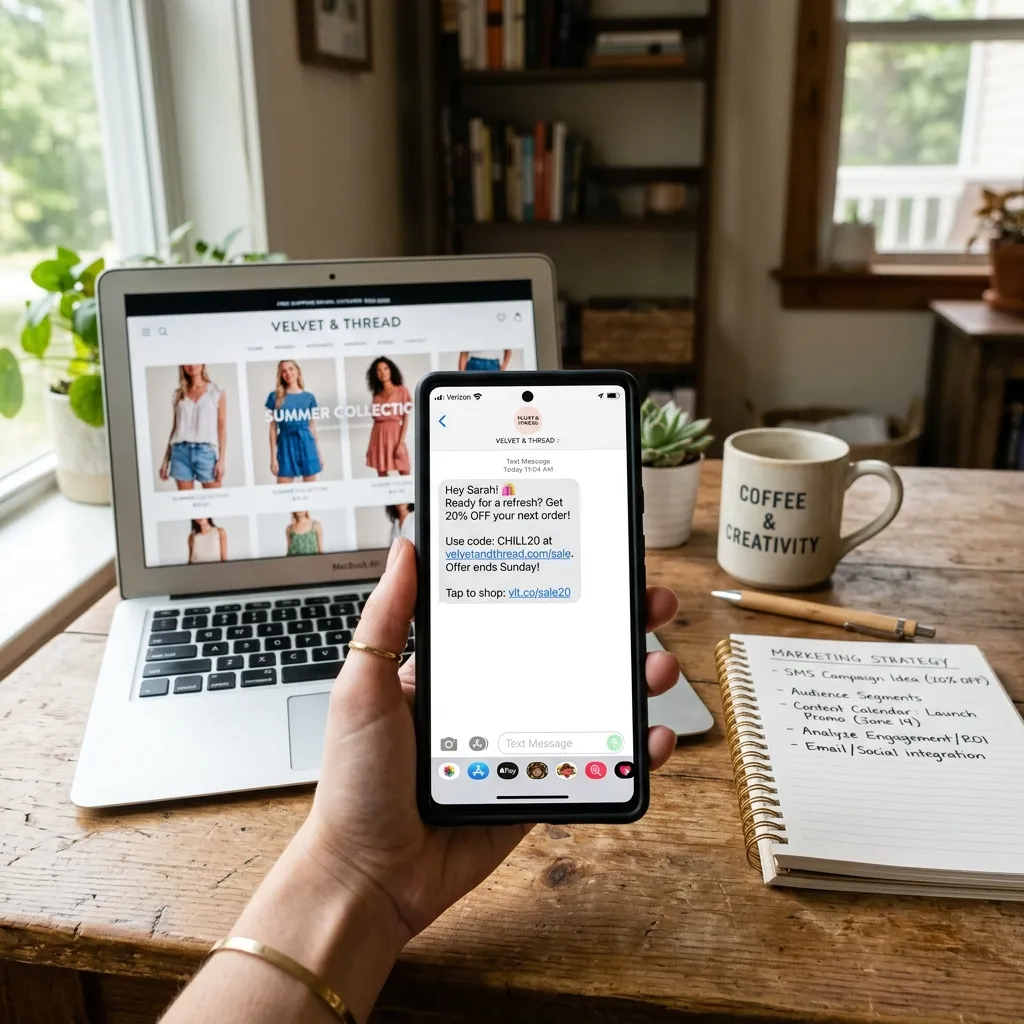 Ecommerce SMS marketing is the practice of sending targeted, permission-based text messages to customers who have opted in to receive them. These messages promote products, share exclusive offers, recover abandoned carts, and deliver post-purchase updates—all directly to a shopper’s mobile device.
Unlike email, which competes in a crowded inbox, SMS lands in the same messaging app customers use to text family and friends. That personal placement is why ecommerce text message marketing cuts through digital noise so effectively. Customers who opt in want brief, valuable updates from the brands they trust.
SMS promotions for e-commerce are split into two broad categories. Promotional messages include flash sales, discount codes, new product announcements, and loyalty rewards. Transactional messages cover order confirmations, shipping updates, and delivery notifications. The strongest programs use both.
What are the benefits of SMS campaigns for online stores?
The case for SMS campaigns for online stores rests on several measurable advantages over other channels.
High open rates and instant engagement
Text messages achieve a 98% open rate versus roughly 20% for marketing emails, according to Gartner (2023). Most recipients read an SMS within three minutes of receiving it. Launch a 24-hour flash sale via email, and it may sit unread until the sale is over. Send the same promotion by text, and your audience sees it in real time.
Instant delivery and direct reach
SMS marketing platforms deliver messages directly to a customer’s native messaging app, bypassing spam filters, algorithmic feeds, and cluttered inboxes. Customers carry their phones everywhere. A text reaches them whether they are at home, commuting, or browsing a competitor’s store.
Cost-effectiveness compared to paid channels
SMS requires no expensive creative production and no bidding wars. You pay for platform access and per-message fees, then reach an audience that already opted in. Because behaviorally targeted messaging converts efficiently, the return per dollar spent frequently outpaces both email and paid social.
Personalization at scale
Modern SMS marketing platforms use dynamic data insertion to pull a customer’s name, reference their last purchase, and recommend a complementary product—automatically. “Hi Emma, the running shoes you viewed are 20% off today” performs significantly better than a generic blast. That precision lifts repeat-purchase rates without requiring manual effort.
How do you build an SMS strategy for ecommerce?
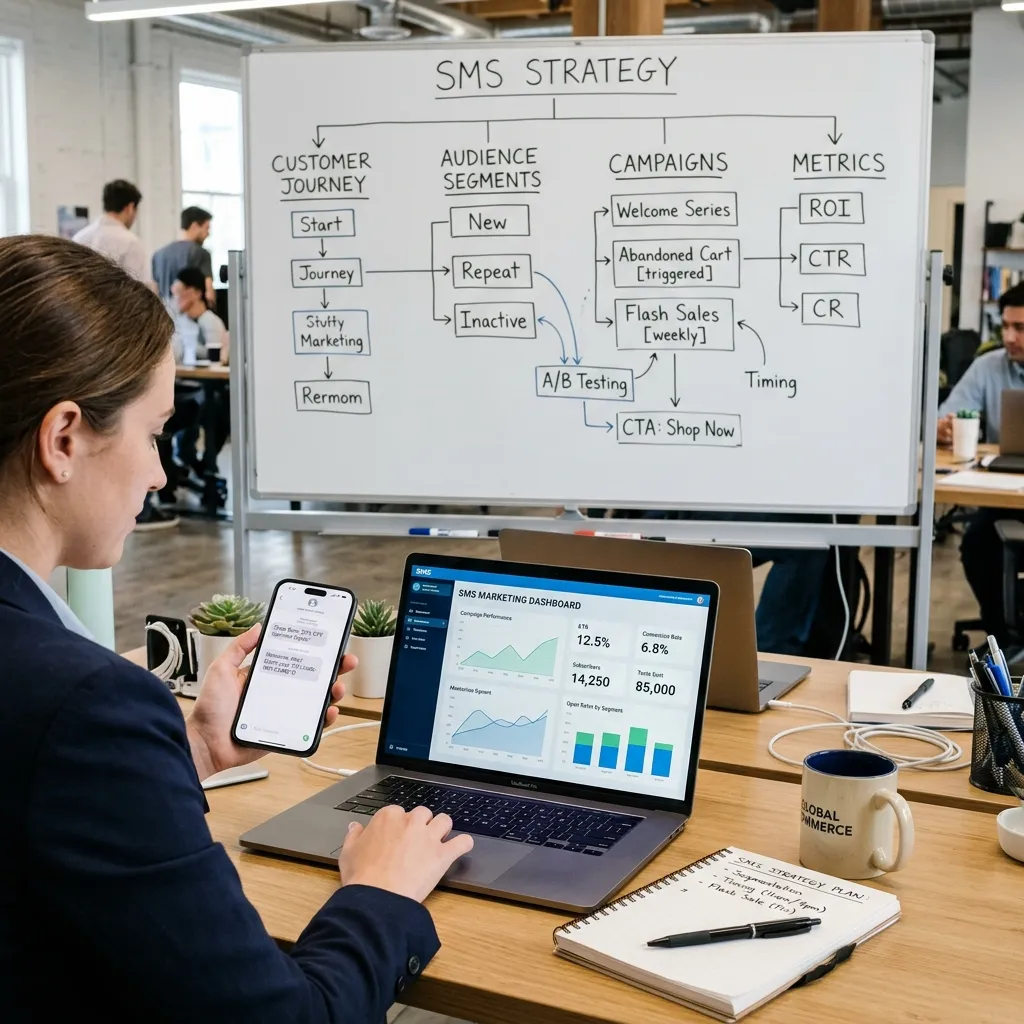 A profitable ecommerce SMS marketing program starts with clear goals, a quality subscriber list, and strict compliance. These foundations determine everything that follows.
Setting clear objectives
Define your goals before sending a single message. Common objectives for SMS campaigns for online stores include driving immediate sales, recovering abandoned carts, building customer loyalty, and promoting new products. Each goal shapes which campaigns you run and which metrics you track.
Audience segmentation and targeting
Segmentation divides your subscriber list into groups based on shared traits, allowing you to tailor messages to each group’s specific interests.
Effective segments for ecommerce include:
- New subscribers who haven’t purchased yet
- Returning customers who buy regularly
- Cart abandoners who left products behind without checking out
- VIP buyers who represent your highest lifetime value
- Lapsed customers who haven’t purchased in 90 or more days
Targeted messages dramatically outperform generic broadcasts in every measurable metric. For a deeper look at building a segmentation framework, the SMS marketing for online stores ultimate guide covers audience grouping in detail.
Choosing the right SMS platform
Your platform determines what you can automate, how you track results, and how easily you stay compliant.
Look for these core features:
- Automation workflows triggered by customer behavior (sign-ups, purchases, cart abandonment)
- Analytics dashboards that monitor click-through rates, conversions, and opt-out rates in real time
- Ecommerce integrations with Shopify, WooCommerce, or Magento
- Two-way messaging for customer service interactions
Compliance with TCPA, GDPR, and CTIA
You cannot legally send promotional texts to anyone who hasn’t explicitly opted in. In the United States, the Telephone Consumer Protection Act (TCPA) governs mobile marketing. In Europe, the General Data Protection Regulation (GDPR) controls how businesses collect and process personal data. CTIA guidelines add further industry standards.
To stay compliant:
- Use double opt-in to confirm consent with a clear record
- State exactly what types of messages subscribers will receive and how often
- Include “Reply STOP to cancel” in every promotional message
- Ensure your platform processes opt-out requests automatically and immediately
Compliance isn’t just a legal requirement—it protects your subscriber list quality and long-term deliverability.
What types of SMS promotions work best for ecommerce?
Not every message serves the same purpose. The strongest ecommerce text message marketing programs blend multiple campaign types throughout the year.
Welcome series
The welcome series is the first impression your brand makes over SMS. Trigger the first message the moment a new subscriber joins your list, delivering the incentive you promised at opt-in—typically a 10% discount code. Follow up two days later with your best-selling products or a brand story that builds connection. This sequence turns curious browsers into confident first-time buyers.
Abandoned cart reminders
Cart abandonment is one of ecommerce’s most persistent revenue leaks. According to the Baymard Institute (2023), the average documented cart abandonment rate sits at nearly 70%. An automated SMS recovery sequence targets those high-intent shoppers directly.
A proven three-step sequence:
- 30–60 minutes after abandonment: Gentle reminder with a direct cart link
- 24 hours later: Introduce a small incentive like free shipping
- 48–72 hours later: Final “last chance” message
Keep the sequence to three messages maximum. For a full playbook on setting this up, review the abandoned cart SMS strategy guide.
Flash sales and limited-time offers
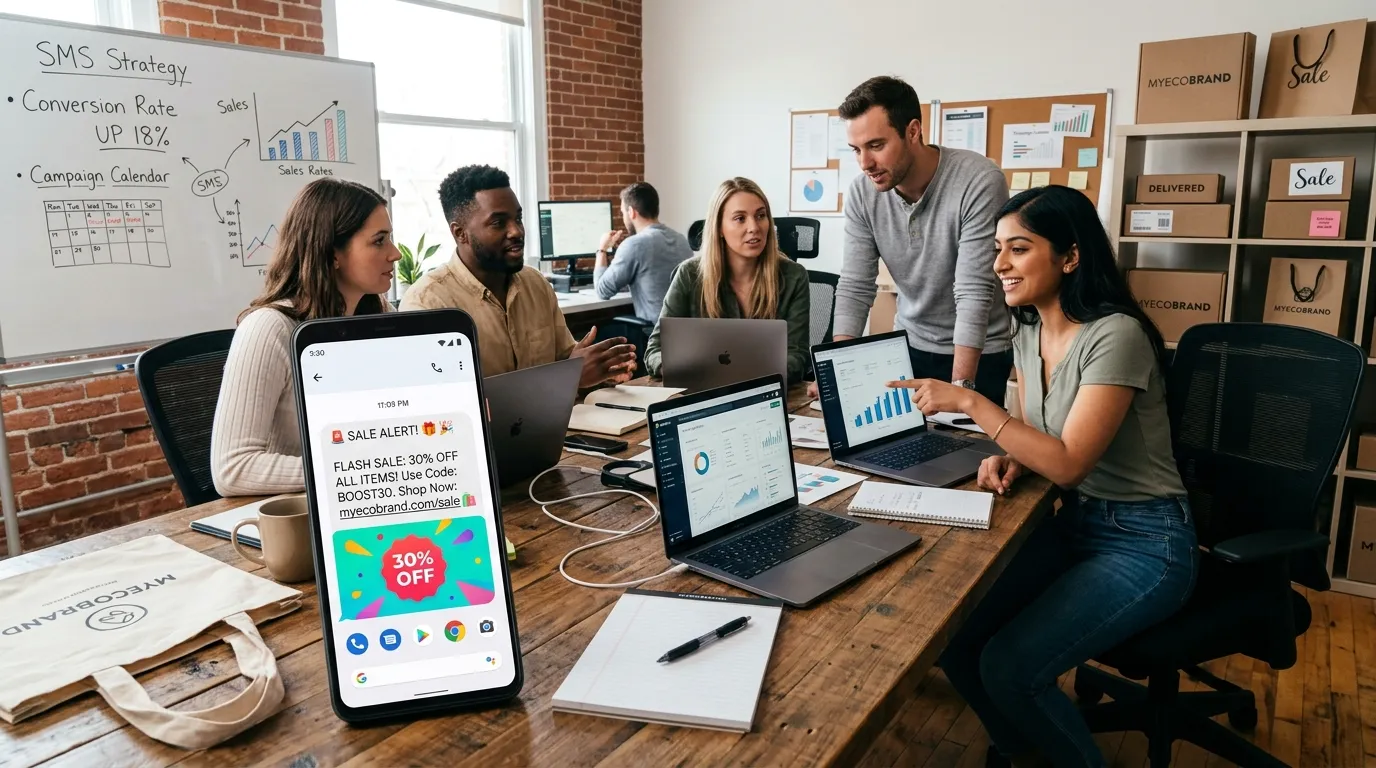
Flash sales generate immediate urgency. Because text messages are read within minutes, SMS is the ideal channel for 24-hour promotions. A text announcing a limited-time sale forces an immediate decision in a way that an email scheduled for “tomorrow morning” never can.
Create genuine scarcity through specific deadlines and limited stock signals. Avoid vague urgency language—customers learn to ignore it.
Product launch announcements
Give subscribers early access to new inventory before it goes public. This exclusivity makes the opt-in feel genuinely valuable and creates a sense of belonging that generic promotional emails can’t replicate. Early-bird access texts consistently generate higher conversion rates than standard launch emails.
Loyalty programs and VIP offers
Reward your most valuable customers with subscriber-only perks. Notify loyalty members when they accumulate enough points for a reward, send birthday discounts, and offer early access to clearance events. VIP SMS programs strengthen retention and reduce churn among high-value segments.
Back-in-stock alerts
A shopper who wanted a product and couldn’t get it is a highly motivated buyer. Back-in-stock SMS alerts capitalize on that existing demand. Personalized notifications referencing the specific product a customer viewed or wishlisted convert at significantly higher rates than generic “we’re restocked” messages.
Order confirmations and shipping updates
Transactional messages build trust and reduce support volume. Send an order confirmation immediately after purchase, then trigger a shipping update with a tracking link the moment the package ships. Delivery confirmations complete the loop. These messages also create natural cross-sell opportunities—a shipping update for a yoga mat is a perfect moment to recommend a matching block or strap.
How do you craft effective SMS campaigns for online stores?
 Great strategy means nothing without strong execution. Every element of your message—the copy, timing, and frequency—directly affects conversions.
Best practices for SMS copywriting
Standard SMS limits you to 160 characters. Every word must pull its weight.
Follow this structure:
- Identify your brand immediately
- State the offer or value clearly
- Include a strong, direct call to action
- Add a shortened, mobile-friendly link to the relevant product page
Weak example: “Hey! We have some great stuff happening at our store this week.”
Strong example: “BRAND: 20% off sitewide — today only 🛍️ [link] Reply STOP to opt out.”
Use first names and behavioral data to personalize whenever possible. One well-placed emoji adds personality. A string of them triggers carrier filters and looks unprofessional.
Timing your messages for maximum impact
Send promotional texts between 9:00 AM and 8:00 PM in the recipient’s local time zone. Mid-afternoon and early evening typically generate the highest click-through rates. Limit promotional blasts to two to four per month to maintain list health. Sending too frequently drives up opt-out rates and damages your sender reputation.
Strong calls to action that drive clicks
Replace weak CTAs with verb-driven, specific alternatives:
|
Weak CTA |
Strong CTA |
|---|---|
|
“Click here” |
“Claim your 20% off now” |
|
“Learn more” |
“Tap to shop the sale” |
|
“Visit our site” |
“Unlock free shipping today only” |
Create genuine urgency through expiration dates and inventory limits. Artificial urgency—claiming a sale ends “soon” with no deadline—trains subscribers to tune out your offers.
Integrating SMS with email and social media
SMS works best when it amplifies your other channels rather than operating in isolation. Use email for detailed announcements and long-form content. Use social media for brand awareness. Rely on SMS for urgent, high-converting alerts. A practical sequence: send an email announcing a weekend sale on Friday, then follow up with an SMS four hours before the sale ends. For a full framework on connecting these channels, explore this omnichannel SMS and email integration guide.
What are advanced strategies for ecommerce text message marketing?
Once your core campaigns run smoothly, advanced tactics extract more value from every subscriber on your list.
A/B testing your SMS campaigns
Never assume you know what will perform best. A/B testing sends two message variations to a small audience subset and sends the winning version to the remainder of the list. Test one variable at a time—offer type, CTA wording, send time, or message length. Small, consistent improvements compound quickly across large subscriber bases.
Leveraging SMS for customer service
Two-way texting transforms a one-sided broadcast into an interactive channel. Allow shoppers to reply with questions about sizing, shipping, or returns. Resolving queries via text increases the likelihood of a completed sale and significantly strengthens customer relationships.
AI-powered personalization
Modern SMS platforms use artificial intelligence to analyze browsing behavior and purchase history, predicting the exact moment each subscriber is most likely to buy. AI-driven send-time optimization, dynamic content generation, and automated A/B testing are increasingly accessible to mid-market ecommerce brands—not just enterprise-level retailers.
How do you measure the success of SMS promotions for ecommerce?
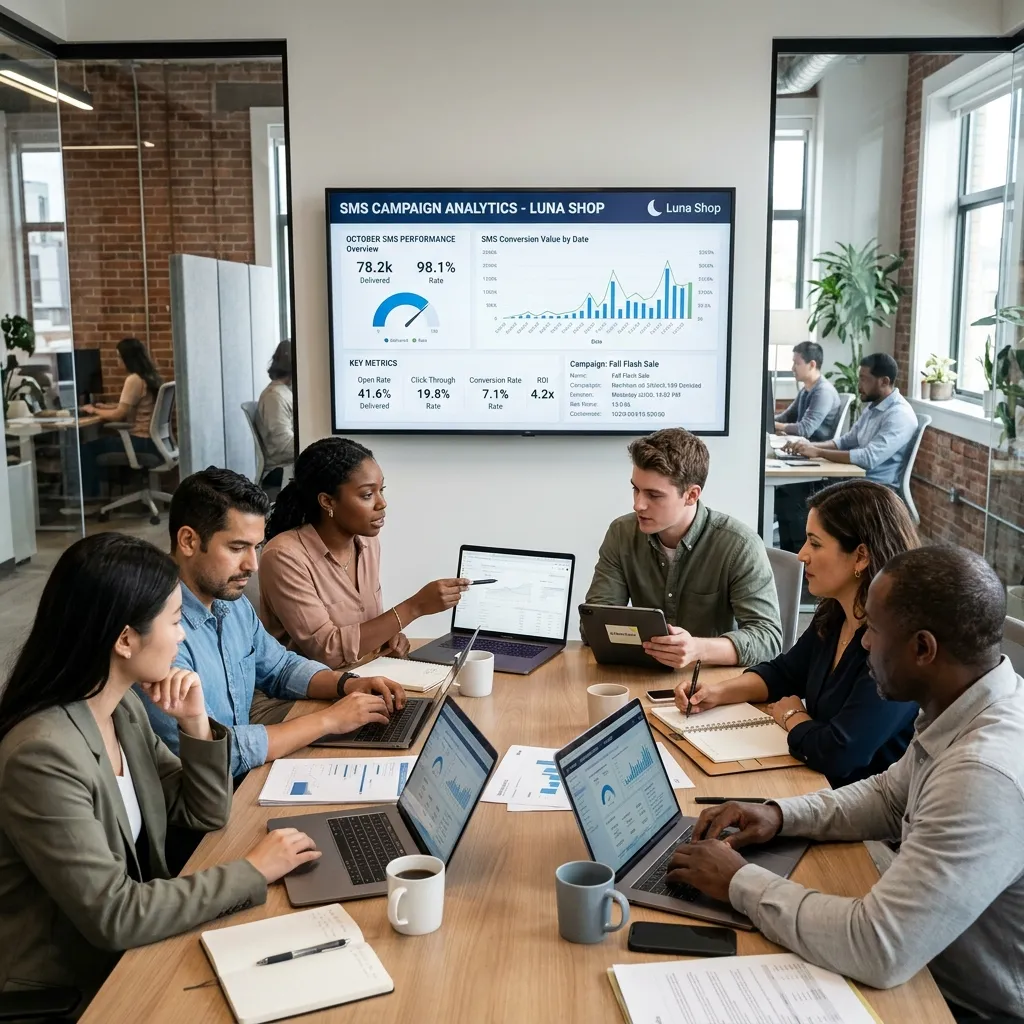 Sending texts is only half the work. Tracking performance after every campaign is where real, sustainable growth comes from. Monitor these key metrics:
- Delivery rate: Confirms your list is clean and messages are reaching devices
- Click-through rate (CTR): Shows whether your offer and CTA resonate
- Conversion rate: Reveals what percentage of clicks result in purchases
- Return on investment (ROI): Ties campaign revenue directly to cost
- Opt-out rate: Signals whether messages are too frequent or irrelevant
Use trackable links and unique discount codes to attribute revenue to specific campaigns. For a deep dive into tracking methodology, the SMS conversion optimization guide covers metric selection and ROI calculation in full.
Conclusion
SMS promotions for ecommerce have become one of the most effective ways to connect with customers instantly and drive sales. With high open rates and direct communication, ecommerce SMS marketing helps brands promote offers, recover abandoned carts, and build stronger customer relationships. When combined with a smart strategy, personalized messaging, and proper timing, SMS campaigns for online stores can significantly boost engagement and conversions. For ecommerce businesses looking to grow faster and improve customer retention, SMS marketing is no longer optional—it is a powerful channel for sustainable growth.
Frequently Asked Questions
1. What are SMS promotions for ecommerce?
SMS promotions for ecommerce are opt-in text messages—discount codes, flash sale alerts, product announcements, and cart reminders—sent directly to shoppers’ mobile devices to drive immediate sales and repeat purchases.
2. How effective is ecommerce SMS marketing compared to email?
Ecommerce SMS marketing achieves a 98% open rate versus roughly 20% for email, according to Gartner (2023). Most text messages are read within three minutes of delivery, making SMS significantly faster and more visible for time-sensitive campaigns.
3. Is SMS marketing for ecommerce legal?
Yes, provided businesses obtain explicit opt-in consent before sending messages. Online stores must comply with the TCPA in the United States, GDPR in Europe, and CTIA industry guidelines, and must include a clear opt-out option in every promotional message.
4. How do ecommerce stores build an SMS subscriber list?
Offer a clear incentive—such as a discount code or free shipping—via website pop-ups, checkout opt-in checkboxes, social media campaigns, and in-person keyword sign-ups. A double opt-in process is recommended for compliance and list quality.
5. How often should an online store send promotional SMS messages?
Most successful ecommerce SMS marketing programs limit promotional messages to two to four per month. Transactional messages, such as order confirmations and shipping updates, can send more frequently because customers expect and welcome them.
6. Which SMS campaign delivers the highest ROI for ecommerce?
Abandoned cart recovery campaigns consistently deliver the highest ROI. These messages target shoppers who already demonstrated purchase intent, making them more likely to complete checkout than cold-audience segments.
7. What should a high-converting SMS promotion include?
A high-converting message identifies the brand immediately, states the offer clearly, uses a strong verb-driven call to action, includes a shortened mobile-friendly link to the relevant product page, and adds an opt-out instruction. The entire message should fit within 160 characters.
8. How much do SMS campaigns for online stores typically cost?
Costs vary by platform and message volume, but typically include a monthly platform subscription plus per-message fees. Because conversion rates are high relative to other channels, the overall cost-per-acquisition tends to be lower than paid social or display advertising.
9. Can SMS promotions for ecommerce be fully automated?
Yes. Automation workflows trigger messages based on customer actions—new sign-ups, purchases, cart abandonment, or inactivity. Automated sequences like welcome series and cart recovery run continuously without manual effort, delivering the right message at the right moment every time.
10. How do you measure the ROI of ecommerce text message marketing?
Track click-through rates, conversion rates, and total revenue using unique tracking links and discount codes assigned to each campaign. Most SMS platforms provide built-in dashboards that connect message performance directly to sales data in real time.