

Discover how SMS Marketing Analytics can transform your campaigns. Learn about essential tools, key metrics, and actionable insights to track performance, improve engagement, and maximize ROI for your text message marketing strategies.
Why SMS Marketing Analytics Matter
In a world where consumers expect personalized interactions and instant gratification, SMS marketing analytics plays a pivotal role in shaping effective communication strategies. Without clear data, marketers operate on assumptions, leading to misaligned content and suboptimal timing. By contrast, leveraging performance metrics ensures every message is informed by actual subscriber behavior and engagement trends.
One key advantage of SMS marketing analytics is the ability to measure campaign performance at multiple levels. From delivery rates to on-site conversions, granular data points empower teams to pinpoint strengths and weaknesses. For instance, if a particular promotion yields high open rates but low click-through results, marketers can adjust link placement or refine calls to action to drive better responses. Similarly, tracking opt-out trends reveals whether message frequency or content relevance is causing subscriber fatigue.
Additionally, analytics foster budget accountability by tying costs directly to outcomes. When you know exactly how much revenue each text message generates, it becomes possible to allocate spending toward high-performing segments and halt investments in underperforming tactics. This level of financial transparency is critical for securing ongoing buy-in from stakeholders and justifying SMS programs as cost-effective marketing channels.
Beyond immediate gains, data-driven SMS campaigns facilitate continuous improvement. By establishing benchmarks—such as industry-standard click-through rates of 10% to 30%—you can set realistic goals and measure progress over time. Regularly reviewing these KPIs ensures that your mobile strategy evolves in line with changing audience preferences and market dynamics. Ultimately, SMS marketing analytics transforms guessing games into strategic decision making, driving sustained growth and long-term success.
Essential Metrics to Monitor for SMS Campaigns
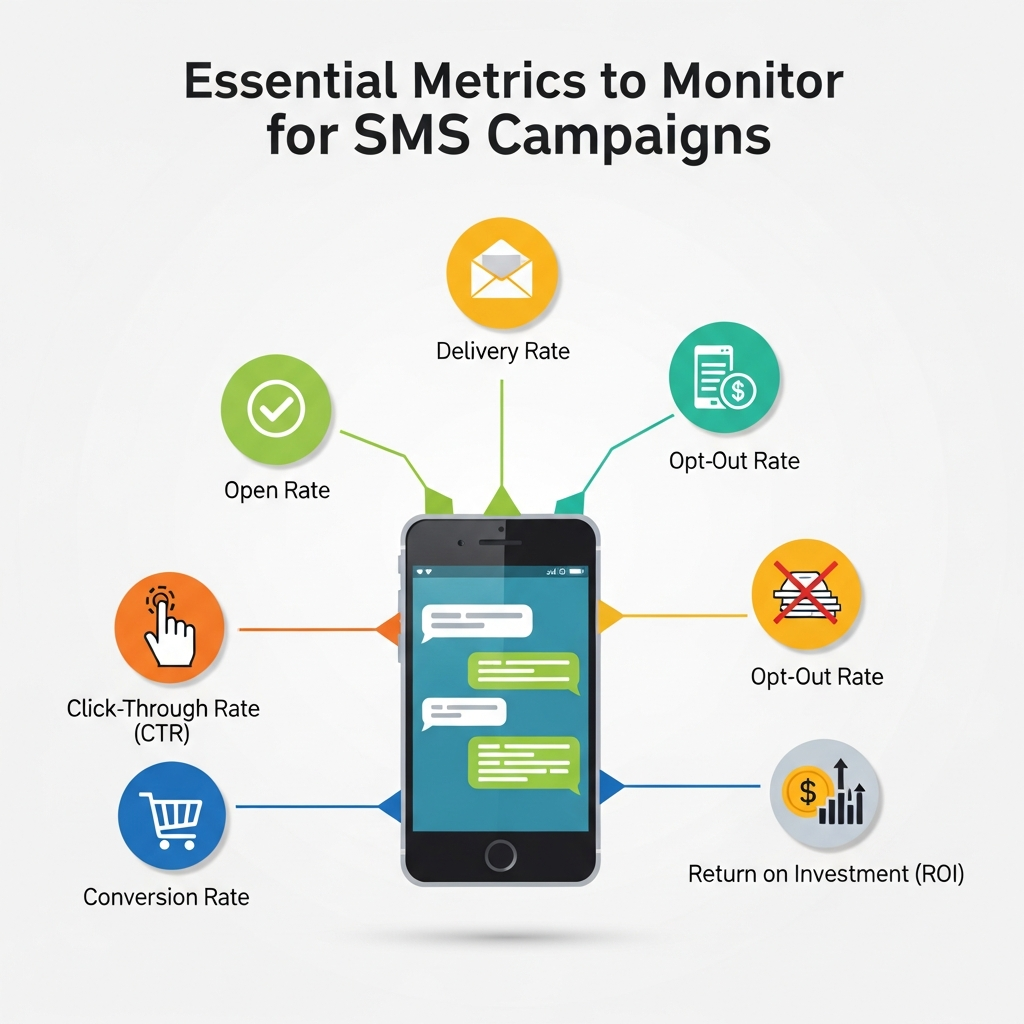 Successful SMS marketing analytics revolves around tracking the right performance indicators. Below are the critical metrics that every mobile marketer should monitor to ensure campaigns deliver optimal results.
Delivery Rate
Delivery rate measures the percentage of messages that reach recipients’ devices without bouncing. A high delivery rate, generally above 95%, reflects strong carrier relationships and a clean subscriber list. If you observe delivery issues, consider auditing phone number validity, updating compliance protocols, or switching providers to improve reliability.
Click-Through Rate (CTR)
Click-through rate represents the portion of delivered texts where recipients follow embedded links. CTR offers insight into how compelling your copy and calls to action are. Benchmarks vary by industry, but achieving a CTR between 10% and 30% indicates strong engagement. Experiment with different link formats, button text, and placement to optimize this metric.
Conversion Rate
Conversion rate captures the percentage of clicks that lead to desired actions, such as purchases or form submissions. By integrating SMS data with your CRM or web analytics platform, you can track the customer journey from text to transaction. Utilize UTM parameters and APIs to attribute conversions accurately and understand campaign ROI.
Opt-Out Rate
Opt-out rate reveals the share of subscribers who unsubscribe after a message. Maintaining this rate under 1% helps preserve list health and engagement. Excessive unsubscribes often signal issues with content relevance, message frequency, or timing. Use opt-out data to adjust strategy and minimize attrition.
Response Rate
Response rate measures the percentage of recipients who reply to two-way SMS campaigns, such as surveys or chatbots. A higher response rate indicates deeper engagement and can serve as an indicator of brand affinity. Leverage conversational messaging to foster two-way communication and gather customer feedback.
Revenue per Message (RPM) and ROI
Revenue per message calculates average income generated per text, while ROI compares campaign revenue against total costs. Monitoring RPM and ROI helps you forecast budget needs, validate program success, and secure executive support for future initiatives. Regular financial reviews ensure that your SMS marketing analytics framework remains aligned with business objectives.
Top Platforms and Tools for SMS Marketing Analytics
 Choosing the right analytics solution is essential for capturing accurate insights and driving data-informed decisions. Below are some of the leading platforms that excel in SMS marketing analytics.
Twilio
Twilio’s programmable messaging API offers detailed dashboards for tracking delivery, failure, and engagement metrics in real time. With webhook support, you can export performance data into your data warehouse or business intelligence tools for advanced analysis. Twilio’s extensive documentation and developer community ensure seamless integration with existing systems. Learn more about RCS vs SMS and rich messaging to see how Twilio can enhance richer messaging strategies.
Klaviyo
Klaviyo unifies SMS and email data to provide a comprehensive view of multi-channel performance. By linking purchase history and subscriber behavior, it enables precise audience segmentation and revenue attribution. Klaviyo’s dashboard highlights key SMS marketing analytics alongside e-commerce metrics, helping marketers optimize campaigns holistically.
Postscript
Postscript is designed for Shopify merchants who need an intuitive analytics suite tailored to texting campaigns. It tracks metrics such as subscriber growth, message performance, and revenue per campaign. Automated reports spotlight top-performing automations and suggest timing and content adjustments for improved results.
Google Analytics Integration
Tagging your SMS links with UTM parameters allows you to funnel data into Google Analytics, where you can measure on-site behaviors like bounce rate, session duration, and goal completions. This approach reveals how SMS marketing drives broader engagement and contributes to long-term customer journeys. See Google’s guide for more details: Google Analytics Help.
Industry-Specific and Dedicated Platforms
Beyond general-purpose tools, there are specialized platforms such as Sprout Social and MightySignal that offer SMS-centric analytics features. These solutions often include cohort analysis, sentiment tracking, and predictive performance models that help marketers anticipate trends and adjust tactics proactively.
Strategies to Leverage Data and Enhance Campaign Performance
Collecting data is only the first step; applying insights effectively is what drives results. By combining analytics with actionable strategies, marketers can continuously improve SMS campaign performance. Below are proven approaches to transform raw data into measurable impact.
1. Conduct A/B Tests
Regular testing helps uncover what resonates with your audience:
- Test variations in message copy, CTAs, send times, and offers
- Use control groups and statistically significant sample sizes
- Track performance for each variation and iterate over time
Example: Test “Limited Time Offer” vs. “Exclusive Deal” as CTA copy to see which drives higher CTR.
2. Refine Segmentation
Segmentation improves relevance and engagement:
- Segment by purchase history, location, or prior interactions
- Tailor messages for each audience group
- Use behavior-based triggers to deliver timely content
Benefits: Personalized content increases open rates, click-through rates, and conversions.
3. Optimize Frequency and Timing
Timing and cadence are critical to avoid subscriber fatigue:
- Analyze past engagement data to identify optimal send times
- Adjust frequency based on response patterns and opt-out trends
- Target peak engagement windows like lunch hours or early evenings
Tip: Over-messaging can increase unsubscribes, while under-messaging reduces opportunity.
4. Leverage Dynamic Content
Personalization at scale enhances engagement:
- Use merge tags for customer names and location-specific offers
- Include product recommendations based on past behavior
- Adapt messages dynamically based on subscriber actions
Result: Messages feel personal and actionable, boosting CTR and conversions.
5. Monitor Industry Benchmarks
Stay competitive by comparing your performance to industry standards:
- Consult authoritative sources like the Pew Research Center or CTIA
- Benchmark delivery rates, CTR, and RPM against similar campaigns
- Identify gaps and set realistic performance targets
Table: SMS Campaign Metrics vs Industry Benchmarks
| Metric | Average Industry Benchmark | How to Improve |
|---|---|---|
| Delivery Rate | 95–98% | Maintain list hygiene and validate opt-ins |
| Open Rate | 90–98% | Send during peak engagement times |
| Click-Through Rate (CTR) | 10–20% | Use strong CTAs and dynamic content |
| Conversion Rate | 2–5% | Personalize offers and optimize landing pages |
| Opt-Out Rate | <2% | Balance frequency and provide clear opt-out options |
Best Practices for Sustainable SMS Marketing Success
 Beyond analytics, maintaining trust, compliance, and long-term engagement is crucial.
Maintain List Hygiene
- Remove inactive numbers regularly
- Correct formatting errors and invalid numbers
- Validate opt-ins to reduce bounce rates
Impact: Clean lists improve deliverability and ensure analytics reflect meaningful engagement.
Ensure Compliance and Privacy
- Follow regulations like TCPA and GDPR
- Clearly communicate opt-in terms and opt-out options
- Protect subscriber data to build trust
Implement Cross-Channel Integration
- Combine SMS with email, social media, and in-app notifications
- Create unified customer journeys
- Leverage analytics across channels for holistic insights
Tip: Multi-channel insights help optimize engagement strategies across the buyer journey.
Focus on Value-Driven Messaging
- Send content that provides real benefits: exclusive offers, reminders, or personalized recommendations
- Avoid sending irrelevant messages that may reduce engagement
- Highlight time-sensitive or location-based promotions to drive action
Regularly Review and Iterate
- Conduct monthly or quarterly analytics reviews
- Identify trends, test new strategies, and adjust campaigns
- Adopt an agile approach to respond to emerging patterns
Key Outcome: Continuous iteration ensures campaigns remain effective in a fast-paced market.
Summary of Key Strategies (Bullet Points)
- Conduct A/B tests for copy, CTA, timing, and offers
- Segment audiences based on behavior and demographics
- Optimize send frequency and timing using historical data
- Leverage dynamic, personalized content for higher engagement
- Compare campaign performance with industry benchmarks
- Maintain list hygiene and subscriber trust
- Ensure compliance with TCPA, GDPR, and other regulations
- Integrate SMS with other marketing channels
- Prioritize value-driven messaging
- Review analytics regularly and iterate campaigns
FAQ
1. What is SMS marketing analytics?
SMS marketing analytics refers to tracking and analyzing key performance metrics—such as delivery rates, click-through rates, conversion rates, and revenue per message—to optimize text-based campaigns. It helps marketers measure ROI, identify top-performing campaigns, refine targeting, and make data-driven decisions for better results.
2. How often should I review my SMS campaign data?
Regular reviews are essential. For smaller campaigns, monthly assessments may suffice. High-volume or time-sensitive campaigns benefit from weekly or even daily checks to spot trends, identify underperforming segments, and quickly adjust messaging strategies to maximize engagement and revenue.
3. Which metrics are most critical for assessing success?
The most important metrics include:
- Delivery Rate: Percentage of messages successfully delivered
- Click-Through Rate (CTR): Percentage of users clicking embedded links
- Conversion Rate: Users completing a desired action (purchase, signup, etc.)
- Revenue Per Message (RPM): Revenue generated per SMS sent
- Opt-out Rate: Measures list health and content relevance
Tracking these gives a holistic view of campaign effectiveness.
4. Can I integrate SMS analytics with other marketing channels?
Yes! Using UTM parameters, API integrations, and marketing platforms, SMS data can be combined with email, social media, and website analytics. This provides a unified view of customer journeys, helping optimize cross-channel campaigns and measure the true ROI of integrated strategies.
5. How can I use SMS analytics to improve targeting?
By analyzing subscriber behavior, click patterns, and engagement times, marketers can segment audiences effectively. For example, high-engagement users can receive exclusive offers, while inactive users may receive re-engagement campaigns. This improves personalization, relevance, and campaign efficiency.
6. What tools can I use for SMS marketing analytics?
Popular tools include:
- Native CPaaS dashboards from providers like Twilio or MessageBird
- Marketing automation platforms like Klaviyo, HubSpot, or ActiveCampaign
- Google Analytics via UTM tracking for campaign attribution
- Custom dashboards using Excel or BI tools for advanced metrics
These tools help track KPIs, visualize performance, and optimize campaigns in real time.
7. How do I calculate ROI for SMS campaigns?
SMS ROI is calculated by comparing revenue generated to the cost of sending campaigns:
ROI = (Revenue from SMS – Cost of SMS) / Cost of SMS × 100
Tracking ROI helps marketers allocate budgets efficiently and identify which campaigns or segments deliver the highest returns.
8. What are common mistakes to avoid in SMS analytics?
Common pitfalls include:
- Ignoring delivery rates or opt-out data
- Focusing only on clicks without tracking conversions
- Overlooking multi-channel interactions
- Failing to segment audiences for targeted messaging
- Not testing campaigns regularly for optimization
Avoiding these mistakes ensures actionable insights and better campaign performance.
9. How can SMS analytics enhance customer engagement?
Analytics reveals what content, timing, and offers resonate most. By understanding open rates, CTR, and response behavior, marketers can optimize messages for higher engagement, personalize content, and send timely reminders—turning simple text campaigns into highly interactive experiences.
10. Can SMS analytics predict future campaign performance?
Yes! By analyzing historical data and trends, predictive models can forecast subscriber behavior, peak engagement times, and expected conversions. This allows marketers to proactively optimize campaigns, test new strategies, and maximize ROI before sending messages.
Conclusion
In today’s competitive environment, SMS marketing analytics is indispensable for turning mobile outreach into a powerful growth engine. By tracking essential metrics—such as delivery rates, click-throughs, and revenue per message—and leveraging top platforms and proven strategies, marketers can fine-tune campaigns and drive measurable returns. Ensuring compliance, maintaining list hygiene, and integrating cross-channel data further solidifies long-term success.
Adopting a data-driven approach to SMS marketing will set your brand apart and foster stronger customer relationships. Embrace analytics today to optimize performance, justify budget allocations, and continuously elevate your SMS initiatives in today’s digital landscape.