

SMS marketing ROI is key for measuring campaign impact. This article covers essential metrics, industry benchmarks, ROI calculation, optimization strategies, compliance tips, and real-world examples to help businesses maximize revenue and engagement from text messaging campaigns.
What SMS Marketing ROI Means and Why It Matters
SMS marketing ROI represents the financial benefit gained from text message campaigns relative to the expenses incurred. Unlike some channels where attribution can become complicated, SMS provides transparent data—from delivery and opens to clicks and conversions—making it simpler to quantify success. Calculating SMS marketing ROI involves subtracting total spend from total revenue generated by text efforts, then dividing that figure by the spend, and multiplying by 100 to arrive at a percentage.
Focusing on SMS marketing ROI offers multiple advantages for modern marketers. First, it drives budget accountability: with clear metrics, you can validate every dollar spent to decision makers. Second, it enhances performance visibility by highlighting which campaigns yield the greatest returns and which need refinement. Third, emphasizing ROI empowers you to make data-driven decisions, redirecting funds to segments, messaging formats, or timing strategies that promise the highest profitability.
Mobile consumers today are overwhelmed with digital noise, making concise, personalized text interactions more valuable than ever. By mastering SMS marketing ROI, you ensure that your campaigns deliver not only reach, but also measurable, sustainable growth. In the sections that follow, we’ll break down the precise metrics to monitor, share standard industry benchmarks, guide you through the ROI formula, and outline proven optimization techniques to help your brand.
Key Metrics to Track for SMS Marketing ROI
Measuring the success of your SMS campaigns requires more than just monitoring opens or clicks. To truly understand ROI, marketers must analyze multiple performance indicators. Below are the essential metrics to track for every SMS marketing campaign, along with actionable tips to improve them.
1. Delivery Rate
- Delivery rate calculates the percentage of messages successfully reaching recipients’ devices.
- A healthy delivery rate is typically above 95%, indicating clean phone lists and proper sender ID setup.
- Rates below 90% may signal carrier filtering issues or outdated subscriber information.
- Tips to improve:
- Regularly clean your contact lists
- Avoid using shortcodes or sender IDs flagged by carriers
- Ensure compliance with carrier and industry guidelines
2. Open Rate
- Open rate shows the proportion of delivered messages that are opened by recipients.
- SMS open rates are famously high, often exceeding 90%, due to the immediacy of text messaging.
- If open rates fall below 85%, consider:
- Adjusting preview text
- Experimenting with alternative send times
- Segmenting your audience for personalized messaging
3. Click-Through Rate (CTR)
- CTR measures the percentage of recipients who click on links in your messages.
- Typical SMS CTR ranges from 10% to 30%, depending on industry and campaign strategy.
- Track clicks using UTM parameters and analytics tools like Google Analytics to tie them directly to campaign performance.
- Pro tips:
- Include strong, actionable CTAs
- Use shortened URLs for better tracking and cleaner messages
- Test different message copy for higher engagement
4. Conversion Rate
- Conversion rate is the percentage of clicks that lead to a desired action, such as purchases, sign-ups, or app downloads.
- Linking conversions to specific SMS campaigns allows you to calculate direct revenue impact.
- Ways to boost conversion:
- Add urgency with limited-time offers
- Personalize offers based on user behavior
- Simplify landing pages for mobile users
5. Revenue per Recipient (RPR)
- RPR divides total campaign revenue by the number of delivered messages.
- This metric indicates how much revenue each SMS generates, feeding directly into ROI calculations.
- Optimizing RPR:
- Segment audiences for targeted promotions
- Experiment with high-value offers
- Use dynamic content to enhance personalization
SMS Marketing Metrics Table
| Metric | Definition | Typical Range / Benchmark | Tips to Improve |
|---|---|---|---|
| Delivery Rate | % of messages reaching recipients’ devices | 95%+ | Clean contact lists, proper sender ID, compliance |
| Open Rate | % of delivered messages opened | 90–98% | Adjust preview text, optimize send time, segment users |
| Click-Through Rate (CTR) | % of opened messages that are clicked | 10–30% | Strong CTAs, shortened URLs, A/B test message copy |
| Conversion Rate | % of clicks completing desired actions | 5–12% | Limited-time offers, personalized content, easy UX |
| Revenue per Recipient | Total campaign revenue ÷ delivered messages | Varies by industry | Segment audience, targeted offers, dynamic content |
Industry Benchmarks and How to Calculate Your SMS Marketing ROI
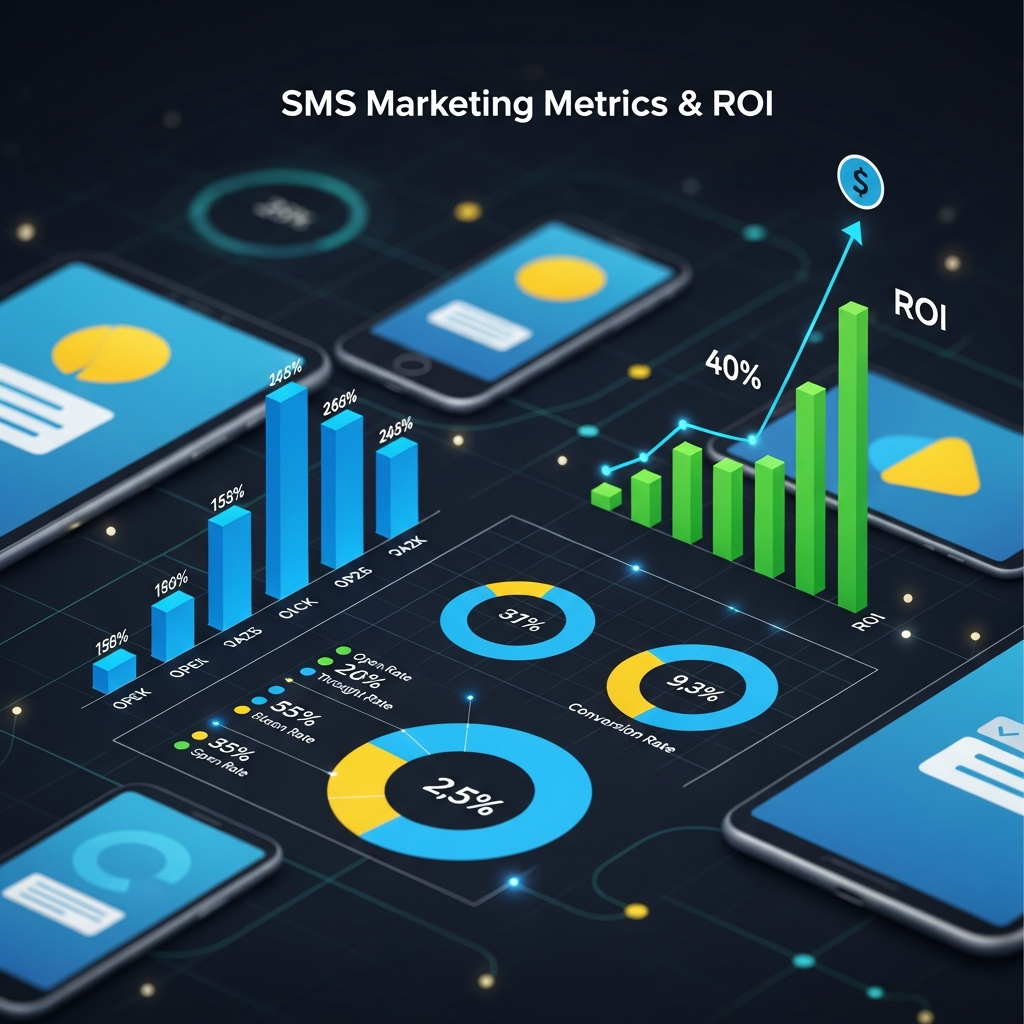 Benchmarks provide essential context, helping marketers compare their performance against industry norms. While exact figures vary by sector, the following general benchmarks serve as a useful starting point in today’s mobile-first marketing landscape:
- Delivery Rate: 95%+
- Open Rate: 90%–98%
- Click-Through Rate (CTR): 10%–25%
- Conversion Rate: 5%–12%
- Average Revenue per Recipient (RPR): $0.10–$0.50 per message
It’s important to note that hyper-targeted campaigns—such as cart abandonment reminders, loyalty program updates, or personalized product recommendations—often outperform broad, untargeted blasts. Historical performance within your own audience segments is frequently the most reliable benchmark. Tracking trends week-over-week or month-over-month enables marketers to identify areas of improvement and scale campaigns that consistently drive results.
Calculating SMS Marketing ROI
Determining the precise return on investment for your text message campaigns is straightforward if you follow a clear formula. At its core, SMS marketing ROI is calculated as:
ROI (%)=Total Revenue Attributed to SMS – Total SMS SpendTotal SMS Spend×100\text{ROI (\%)} = \frac{\text{Total Revenue Attributed to SMS – Total SMS Spend}}{\text{Total SMS Spend}} \times 100
Example Calculation
Imagine a business spends $1,500 per month on SMS marketing, including platform fees and message costs. If their campaigns generate $10,500 in revenue, applying the formula yields:
(10,500–1,500)÷1,500×100=600% ROI(10,500 – 1,500) ÷ 1,500 \times 100 = 600\% \text{ ROI}
In this scenario, every dollar invested in SMS marketing returns six dollars in revenue. This level of insight allows marketers to make data-driven decisions, optimize future campaigns, and justify marketing budgets to stakeholders.
Best Practices for Benchmarking and Tracking ROI
- Segment Your Audience: Compare ROI across different customer segments, such as new subscribers, repeat buyers, or loyalty program members. This helps you identify which groups are most responsive.
- Measure Per Campaign and Per Message: ROI should not only be tracked at the monthly level but also by individual campaigns. This allows you to isolate high-performing messages and understand which strategies are driving the best returns.
- A/B Test Regularly: Experiment with message content, send times, and call-to-action phrasing to see which variations yield the highest conversion rates. Use these insights to inform future campaigns.
- Consider Lifetime Value (LTV): Sometimes ROI from a single campaign doesn’t capture long-term revenue. Include customer lifetime value to understand the full financial impact of SMS marketing.
- Leverage Analytics Tools: Platforms like Google Analytics, Klaviyo, or Postscript allow you to tie SMS clicks and conversions directly to revenue, ensuring accurate ROI attribution.
Real-World Insight
Top-performing e-commerce brands often see ROI well above industry benchmarks by personalizing messages and targeting high-value customers. For example, a fashion retailer sending segmented cart abandonment reminders can generate an ROI exceeding 700%, demonstrating the power of strategic, data-driven SMS campaigns.
By tracking industry benchmarks, applying the ROI formula, and following best practices, marketers can confidently optimize campaigns, allocate budgets effectively, and scale high-performing initiatives. Understanding ROI is not just a metric—it’s a roadmap to maximizing revenue through SMS marketing.
Effective Strategies to Optimize SMS Marketing ROI
 Improving SMS marketing ROI is not simply about sending more messages—it’s about sending the right messages to the right people at the right time. Below are proven tactics to boost returns and maximize revenue per recipient:
Hyper-Segmentation
Segment your subscriber base by demographics, purchase history, engagement level, or location. Hyper-segmented lists enable you to deliver highly relevant offers, which often yield conversion rates well above general campaigns. For example, sending VIP loyalty discounts to top spenders can drive significantly higher average order values.
Personalization Techniques
Incorporate dynamic content fields—such as first names, loyalty points, or tailored product recommendations—to foster a personal connection. Personalized SMS often achieve click-through rates up to 50% higher than generic blasts. Use data from your CRM or CDP to power these customizations.
Automation and Triggered Flows
Set up automated sequences for key customer journeys: welcome messages, cart abandonment reminders, and post-purchase follow-ups. Triggered communications sent at precise moments can deliver conversion rates up to three times higher than one-off manual blasts. Automation platforms like Klaviyo or Attentive streamline this process efficiently.
A/B Testing
Continuously test message components—call-to-action wording, send times, offers, and message length. Even minor adjustments can have a significant impact on open and click rates. Implement iterative testing cycles to identify top-performing variations and scale them across your audience.
Optimized Send Timing
Leverage historical engagement data to determine peak activity windows for your audience. For many industries, mid-morning (9–11 AM) and early evening (5–7 PM) yield the highest response rates. Align your send schedules accordingly to maximize open and click-through potential.
Omnichannel Integration
Combine SMS with email, social media ads, and in-app notifications for cohesive, multichannel campaigns. Coordinated messaging across channels reinforces your offer, drives higher engagement, and ultimately improves SMS marketing ROI by capturing audience attention at multiple touchpoints.
Essential Tools, Compliance, and Real-World Insights
 To effectively manage, analyze, and optimize your SMS marketing ROI, it’s vital to leverage the right technology and adhere to regulatory standards. Below, we highlight the critical components for success:
Dedicated SMS Platforms
Platforms like Twilio, Klaviyo, Postscript, and Attentive provide comprehensive dashboards for tracking delivery, open, click, and conversion metrics in real time. These tools simplify A/B testing, automation, and subscriber management, ensuring your campaigns run smoothly and compliantly.
Analytics and Attribution Suites
Integrate SMS tracking with analytics solutions such as Google Analytics and Adobe Analytics to attribute traffic and conversions accurately. Use UTM codes and event tracking to link SMS engagements back to your overall marketing performance.
CRM and CDP Integrations
Tools like HubSpot, Salesforce, and Segment centralize customer data, enabling deep segmentation, personalization, and cross-channel attribution. Leveraging unified customer profiles elevates your ability to deliver targeted, high-impact messages that drive SMS marketing ROI.
Data Privacy and Compliance
Adherence to regulations such as TCPA in the US, GDPR in the EU, and CASL in Canada is non-negotiable. Non-compliance can result in significant fines and reputational damage. Follow these best practices:
- Obtain explicit opt-in consent via web forms or keyword sign-ups.
- Provide clear, effortless unsubscribe mechanisms in every message.
- Maintain detailed consent records with timestamps.
- Review official guidelines on TCPA at FCC Robocall Rules and GDPR requirements at GDPR.eu.
Case Studies and Lessons Learned
Many brands have demonstrated exceptional SMS marketing ROI through targeted, data-driven strategies:
- E-Commerce Brand: By implementing automated cart abandonment texts, this retailer recovered 25% of lost sales and increased its SMS marketing ROI from 350% to 720% within two quarters.
- Restaurant Chain: Sending geo-targeted lunch deals to local subscribers resulted in a 40% CTR and a 15% conversion rate, yielding a 550% ROI on promotional spend.
FAQ
1. What is a good SMS marketing ROI benchmark?
Ans: Industry benchmarks for delivery, open, and click rates provide context: aim for delivery rates above 95%, open rates between 90%–98%, CTRs of 10%–25%, and conversion rates of 5%–12%. Top campaigns can achieve over 600% ROI.
2. How often should I send promotional SMS messages?
Ans: Frequency depends on your audience and campaign type. Use segmentation to target relevant groups, test different send cadences, and align messages with peak engagement times while avoiding subscriber fatigue.
3. How can I improve click-through and conversion rates?
Ans: Personalize messages, use dynamic content, implement automated flows, run A/B tests, optimize send timing, and integrate SMS with other marketing channels for a cohesive experience.
4. What are the key compliance requirements for SMS marketing?
Ans: Obtain explicit opt-in consent, provide clear unsubscribe options, maintain consent records, and follow regulations such as TCPA (US), GDPR (EU), and CASL (Canada).
5. Which metrics are most important for tracking SMS ROI?
Ans: Track delivery rate, open rate, click-through rate, conversion rate, unsubscribe rate, revenue per message, and overall ROI to assess campaign performance.
6. What type of content performs best in SMS campaigns?
Ans: Short, clear, and actionable messages perform best. Offers, discounts, appointment reminders, event alerts, and personalized recommendations tend to drive higher engagement.
7. Can SMS marketing work for small businesses?
Ans: Yes. SMS allows small businesses to reach customers directly, promote products or services, announce events, and build loyalty, often at a lower cost than other channels.
8. How do I segment my SMS audience effectively?
Ans: Segment based on demographics, purchase behavior, engagement history, location, and preferences. Hyper-segmentation ensures messages are highly relevant and boosts conversions.
9. What tools can help optimize SMS marketing campaigns?
Ans: SMS marketing platforms like Twilio, Attentive, Postscript, or integrated tools in CRM systems help automate messaging, track analytics, and personalize campaigns for better ROI.
10. How can I measure the long-term impact of SMS marketing?
Ans: Monitor trends in repeat purchases, customer lifetime value (CLV), subscriber growth, engagement rates, and campaign ROI over time. Comparing data against other channels helps demonstrate strategic value.
Conclusion
SMS marketing ROI is one of the most reliable indicators of campaign performance in today’s fast-paced digital landscape. By carefully tracking key metrics—such as delivery, open, click-through, and conversion rates—marketers can calculate precise returns on their text message campaigns. Leveraging strategies like hyper-segmentation, dynamic personalization, and automated flows ensures that messages reach the right audience at the right time, maximizing engagement. Coupled with robust analytics and strict adherence to data privacy regulations, these practices allow businesses to optimize their campaigns effectively. Real-world examples show how optimized SMS strategies can deliver substantial ROI, fueling growth and profitability.