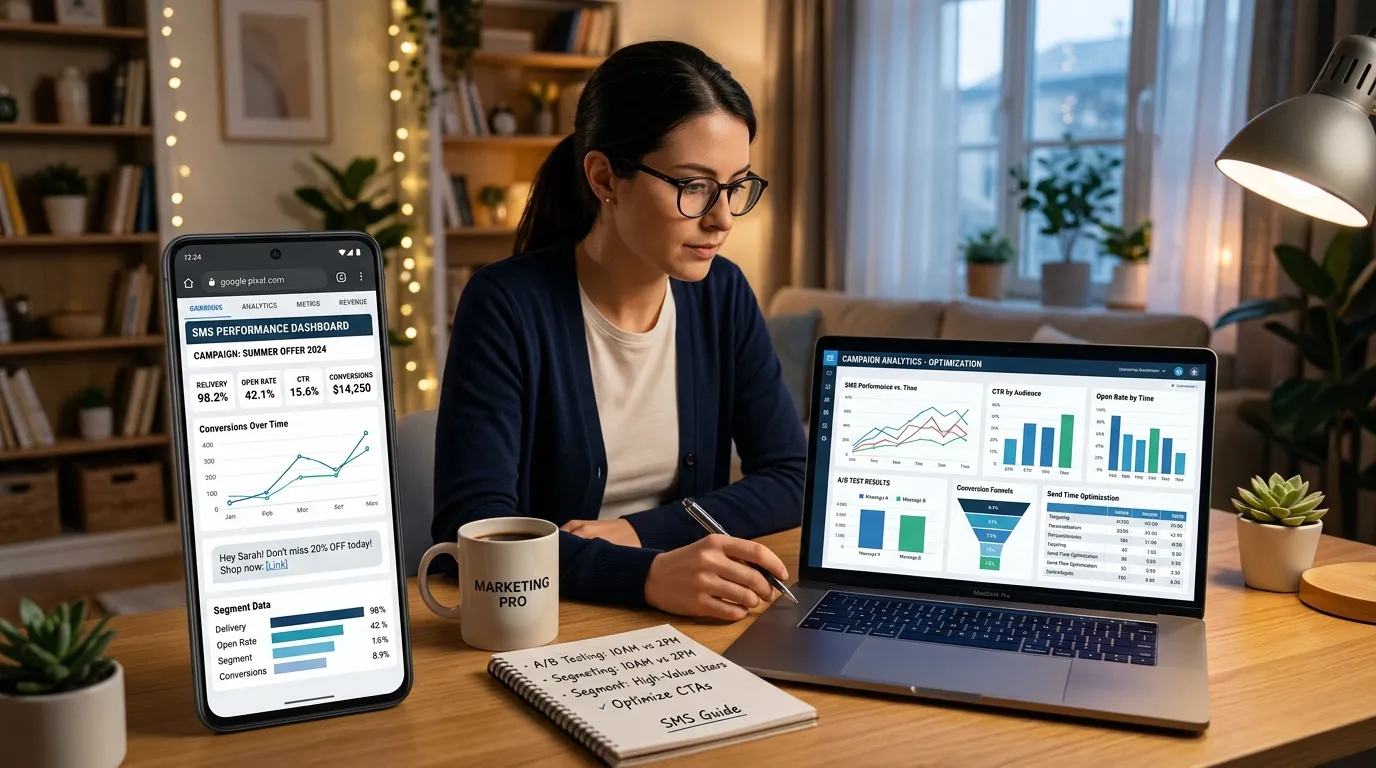
SMS campaign optimization is the process of refining your text marketing strategy—through segmentation, personalization, timing, A/B testing, and analytics—to maximize engagement, conversions, and ROI.
Text messages reach a 98% open rate , making optimization critical for sustainable growth.
SMS marketing is one of the most direct channels available to marketers today. Text messages reach a 98% open rate, compared to roughly 20% for email, according to Gartner (2023). Most recipients read a text within three minutes of delivery. No other channel delivers that kind of immediacy.
Yet many businesses squander it. They blast identical messages to their entire subscriber list, ignore timing, skip personalization, and wonder why conversions stay flat. The gap between an SMS program that drives revenue and one that drains budget almost always comes down to optimization.
SMS campaign optimization is not a one-time fix. It is a continuous process of testing, refining, and improving every element of your text marketing strategy—from how you segment your audience to the exact words in your call to action. Done well, it compounds over time. Each improvement builds on the last, and campaigns that once averaged modest click-through rates start pulling significantly higher conversions.
This guide covers the full SMS marketing optimization process: the fundamentals of audience and content strategy, advanced mobile marketing campaign techniques, step-by-step implementation, common challenges, and the trends reshaping the channel. By the end, you will have a clear and actionable framework to improve every campaign you send.
What Is SMS Campaign Optimization, and Why Does It Matter?
 SMS campaign optimization is the practice of systematically improving every component of your text marketing program to increase engagement, conversion rates, and return on investment. It encompasses audience segmentation, message personalization, send-time analysis, A/B testing, automation setup, and performance tracking.
The case for optimization is straightforward. According to the Baymard Institute (2023), the average documented cart abandonment rate sits at nearly 70%. A well-timed, well-crafted SMS campaign can recover a significant portion of those lost sales—but only if the message reaches the right subscriber, at the right moment, with the right offer. Generic, untargeted blasts consistently underperform against optimized, segmented campaigns in every measurable metric.
Optimization also protects your list. Irrelevant or poorly timed texts are the fastest route to opt-outs, and opt-outs are permanent. A subscriber you lose today cannot be re-engaged without a fresh opt-in. Every campaign you send is either building trust or eroding it.
Understanding the Fundamentals of SMS Marketing Optimization
Strong SMS campaign optimization begins before a single message is written. It starts with a clear understanding of your audience and a deliberate approach to every content decision.
How do you define your audience for more effective SMS campaigns?
Audience understanding is the foundation of every high-performing SMS marketing optimization effort. Without it, even the most polished message falls flat.
Effective audience definition draws on two layers of data: demographics and psychographics. Demographics cover age, gender, location, and purchase history. Psychographics reveal interests, values, and motivations—the deeper reasons behind a buying decision. Together, they build subscriber profiles sharp enough to guide meaningful segmentation.
Customer segmentation divides your list into smaller groups based on shared traits, then tailors each message to that group. Common segments include first-time buyers, repeat customers, cart abandoners, lapsed subscribers, and VIP loyalists. Each group responds to different offers and different messaging approaches. For a deeper breakdown of how segmentation lifts campaign performance, the SMS segmentation benefits for marketing guide covers every key approach.
What makes SMS content more compelling and conversion-ready?
Standard SMS limits you to 160 characters, so every word must earn its place. Effective SMS campaign best practices for content follow three principles: conciseness, personalization, and a strong call to action.
Conciseness means identifying your brand immediately, stating the offer in the first few words, and removing every word that doesn’t move the reader toward action.
Compare these two messages:
- Weak: “Hey! We have some exciting things happening at our store this week.”
- Strong: “BRAND: 20% off sitewide—today only. Claim now: [link] Reply STOP to opt out.”
The second message delivers the brand, offer, deadline, link, and opt-out in one tight package.
Personalization goes well beyond first names. Modern SMS platforms use dynamic data insertion to reference past purchases, recommend relevant products, and trigger messages based on real subscriber behavior. “Hi Jordan, the hiking boots you viewed are 20% off today” outperforms any generic offer because it speaks to what the customer already cares about.
A strong CTA replaces vague instructions with verb-driven, specific directives. “Click here” tells a subscriber nothing. “Claim your 20% off now” removes ambiguity and drives action.
What is the optimal send time for SMS campaigns?
Send timing is one of the highest-leverage variables in SMS marketing optimization. Promotional texts sent between 9:00 AM and 8:00 PM in the recipient’s local time zone consistently generate the highest click-through rates. Mid-afternoon and early evening tend to perform best for most audiences.
Always account for time zones. A “flash sale” text that lands at 2:00 AM earns opt-outs, not conversions. Most modern SMS platforms handle time-zone delivery automatically once set up correctly.
Frequency matters just as much as timing. Limit promotional blasts to two to four per month. Beyond that threshold, subscriber fatigue accelerates and opt-out rates climb.
What compliance rules govern SMS campaign optimization?
Compliance is non-negotiable. In the United States, the Telephone Consumer Protection Act (TCPA) governs promotional text messaging. In Europe, the General Data Protection Regulation (GDPR) controls how businesses collect and process personal data. CTIA industry guidelines add further standards across both markets.
Every promotional SMS program must secure explicit opt-in consent before sending. A double opt-in process—where a subscriber confirms their sign-up with a second action—creates a clear consent record that protects your business legally and improves list quality simultaneously. Every message must also include a clear opt-out instruction, such as “Reply STOP to cancel,” and your platform must process those requests instantly.
Advanced Strategies for SMS Campaign Best Practices
 Once your foundation is solid, these advanced tactics extract significantly more value from every subscriber on your list.
How does A/B testing improve SMS campaign performance?
A/B testing is one of the most reliable tools in mobile marketing campaign optimization. The process sends two message variations to a small subset of your audience, measures which performs better, then rolls the winning version to your full list.
Test one variable at a time—offer type, CTA wording, send time, or message length—so the results are actionable. A test that changes three variables simultaneously tells you that something worked, but not what. Consistent, single-variable testing builds a library of insights that guide every future campaign.
Which automated SMS workflows drive the most consistent results?
SMS automation guarantees the right message reaches the right person at the right moment without manual effort.
Three workflows deliver the highest returns across most industries:
- Welcome series: The moment a subscriber opts in, an automated text delivers the promised incentive. This immediate follow-through builds trust and sets the tone for the entire relationship.
- Abandoned cart reminders: Targeting cart abandoners—shoppers who showed strong purchase intent but didn’t complete checkout—consistently produces the highest conversion rates of any SMS workflow. A timely text with a direct link back to their cart often closes the sale.
- Promotional drips: A sequenced series of messages across several days sustains attention during a sale period without overwhelming any single subscriber.
For a closer look at building these workflows from scratch, the SMS marketing automation strategies guide provides a full framework.
How does integrating SMS with other channels multiply campaign results?
SMS campaign optimization reaches its ceiling when text operates in isolation. Connecting SMS to your broader marketing stack unlocks a multiplier effect.
Email and SMS work best as partners. Email handles detailed announcements, long-form content, and visual storytelling. SMS delivers the urgent, time-sensitive nudge. A proven sequence: send an email announcing a weekend sale on Friday, then follow up with an SMS four hours before the sale ends. The email builds anticipation; the text drives the final decision.
Social media integration converts followers into subscribers. Run text-to-join campaigns across your social channels, then use SMS to give those converts early access to launches or exclusives before they go public.
CRM integration is the most powerful connection of all. A linked CRM gives your SMS program a complete view of every customer, enabling messages triggered by real shopping behavior—purchases, support tickets, or a lapse in activity. The CRM with text messaging guide covers how this integration works in practice.
Which KPIs should you track for ongoing SMS marketing optimization?
Measurement is where sustainable SMS campaign optimization lives.
Focus on metrics that connect directly to revenue rather than vanity numbers like total messages sent:
- Click-through rate (CTR): Reveals whether your offer and CTA resonate with each segment.
- Conversion rate: Shows what percentage of clicks result in actual purchases.
- Opt-out rate: Signals frequency or relevance problems before they erode your list.
- Return on investment (ROI): Ties campaign spend directly to revenue generated.
Track these metrics by segment, not just across your entire list. A segment with a high opt-out rate needs adjustment. A segment with strong conversions is one to scale. Use trackable links and unique discount codes to attribute revenue to specific campaigns with precision.
Practical Implementation: A Step-by-Step Guide to SMS Campaign Optimization

How do you choose the right SMS platform for campaign optimization?
Your platform determines what you can automate, how accurately you track results, and how easily you stay compliant. Prioritize platforms with strong segmentation tools, behavioral automation triggers, real-time analytics dashboards, and native integrations with your ecommerce stack and CRM. The platform should also handle opt-in and opt-out management automatically.
How do you build an SMS subscriber list ethically and effectively?
List quality determines your conversion ceiling. A smaller list of genuinely interested buyers consistently outperforms a large list of disengaged contacts.
Build your list through these proven channels:
- Website pop-ups and forms: Offer a clear incentive—a discount, free shipping, or early access—in exchange for a sign-up.
- In-store sign-ups: Promote a keyword text-to-join campaign at the point of sale and on receipts.
- Keyword opt-ins: Let customers text a keyword to a short code to join instantly.
- Social media promotion: Run text-to-join campaigns across your platforms to convert followers into SMS subscribers.
Always pair these with transparent disclosures about message frequency and content type.
What does a well-optimized SMS campaign look like in practice?
A strong campaign follows a deliberate sequence. Define the goal and identify the segment before writing a word. Then craft a concise message that states the brand, the offer, the deadline, and the CTA within 160 characters. Schedule the send for the optimal time in the recipient’s time zone. Track delivery rate, CTR, conversion rate, and opt-outs in the hours after sending. Finally, document what worked and what to test next.
Continuous monitoring and iteration turn a one-off campaign into a compounding system. The businesses that win with SMS are those that treat every send as both a revenue opportunity and a learning event.
Overcoming Common Challenges in Mobile Marketing Campaigns
Even well-run SMS programs hit hurdles. Knowing them in advance keeps your campaigns healthy.
Low engagement rates typically signal a relevance problem. Generic messages sent to an unsegmented list generate low CTRs because they speak to no one specifically. The fix is tighter segmentation and more targeted offers.
High opt-out rates indicate a frequency or content mismatch. Cap promotional sends at two to four per month and use a preference center that lets subscribers choose their message volume. A spike in opt-outs is a signal—diagnose the cause before sending another campaign.
Message delivery issues often stem from a dirty list or spam-trigger words. Clean outdated numbers regularly, avoid phrases that carrier filters flag, and limit emojis to one per message.
Budget constraints need not limit results. Many platforms operate on a freemium model, removing the financial risk of testing the channel. Segmentation also stretches a tight budget—by targeting only the subscribers most likely to convert, you avoid paying to text people who will never act.
Future Trends in SMS Marketing
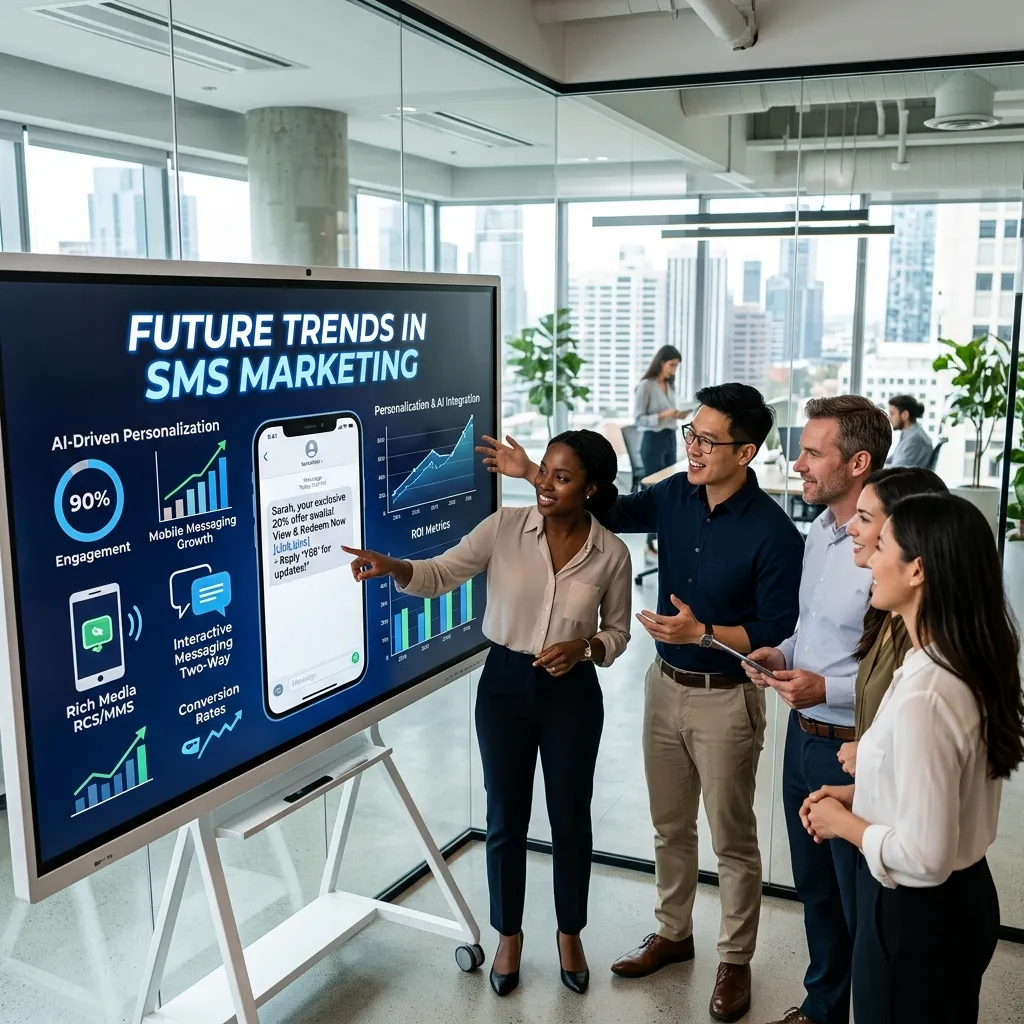 Three developments will reshape SMS campaign optimization over the next few years.
RCS messaging (Rich Communication Services) will let brands send images, video carousels, interactive buttons, and product carousels directly inside the native messaging app. The line between a text and a mini storefront will blur significantly. For a detailed comparison of RCS and standard SMS, the RCS vs SMS guide breaks down the differences and opportunities.
AI-powered personalization will grow more precise. By analyzing browsing and purchase data at scale, AI will predict not just what a subscriber wants but the exact moment they are most likely to buy. Send-time optimization, dynamic content generation, and predictive segmentation—once available only to enterprise retailers—are becoming accessible to businesses of every size.
Enhanced analytics and predictive modeling will connect SMS performance data to the full customer journey, enabling marketers to forecast campaign outcomes before sending and allocate budget with greater accuracy.
Each trend points in the same direction: deeper relevance, richer interaction, and smarter targeting. Marketers who master SMS campaign best practices now will adapt to these shifts far more easily than those still relying on untargeted blasts.
Conclusion
SMS campaign optimization is not a single action—it is a discipline. Every element of your program, from how you collect consent to how you measure conversions, shapes whether your campaigns build revenue or bleed subscribers.
Start with the fundamentals: define your audience, segment your list, craft tight messages with strong CTAs, and send at the right time. Then layer in automation, A/B testing, channel integration, and continuous measurement. Each step compounds the one before it.
The businesses pulling the strongest results from SMS share one habit: they treat every subscriber as an individual, deliver genuine value with every text, and let data guide every decision. Apply that same discipline to your program and the results will follow.
Frequently Asked Questions
1. What is SMS campaign optimization?
SMS campaign optimization is the process of improving audience targeting, message content, timing, and automation to increase engagement, conversions, and ROI. Effective SMS marketing optimization ensures every campaign delivers better results.
2. How often should I send SMS messages?
Following SMS marketing best practices, most businesses should send two to four promotional messages per month. Transactional messages can be sent more frequently because customers expect them.
3. What is a good SMS click-through rate?
A good SMS click-through rate typically ranges from 10% to 30%, depending on the industry and audience. Continuous SMS campaign optimization can help improve SMS campaign performance over time.
4. How can I reduce SMS opt-out rates?
To improve SMS campaign performance, send relevant messages, segment your audience, avoid excessive messaging, and always provide valuable content with an easy opt-out option.
5. Is SMS marketing still effective?
Yes. SMS remains one of the highest-performing marketing channels because of its high open and response rates. Applying SMS marketing best practices helps maximize customer engagement and conversions.
6. What is the difference between SMS and MMS?
SMS contains text-only messages, while MMS supports images, videos, and other multimedia. Both can be included in an effective SMS marketing optimization strategy depending on campaign goals.
7. How do I segment my SMS audience?
Segment customers based on demographics, purchase history, browsing behavior, and engagement. Audience segmentation is a key part of SMS campaign optimization and helps deliver more personalized messages.
8. Can SMS marketing integrate with e-commerce platforms?
Yes. Most SMS platforms integrate with Shopify, WooCommerce, Magento, and other e-commerce systems, making it easier to automate campaigns and improve SMS campaign performance.
9. What are the legal requirements for SMS marketing?
Always obtain customer consent before sending promotional messages and provide a clear opt-out option. Following legal regulations is one of the most important SMS marketing best practices.
10. How can I measure SMS campaign ROI?
Track click-through rates, conversions, revenue, and unsubscribe rates using analytics dashboards. Monitoring these metrics supports continuous SMS campaign optimization and long-term marketing success.